Showing posts with label Animated topics. Show all posts

Saturday, September 17, 2011

From the Eyes of a newbie: up to what extent should an animator rely on live action reference?

A prominent topic of discussion in every art form, and especially when doing it professionally, is the prior preparation work that is required to execute the final piece with maximum success. Animation is no exception at all, and is interesting how in the top elite group of animators the discussion goes to broad extents.

At iAnimate I've been exposed to a lot of top feature studio workflows, ideas and approaches. In Computer Graphics Animation, the level of believability in animated characters demands higher attention to detail and physics of real life, because of how the medium allows us to get a big proximity with real life itself and how accurate and precise the technology allows us to be. But the control over that power still has to come from us animators. I truly think this has a logical justification, and it’s also something I've had to embrace throughout my learning process in the course, to try my best to produce feature quality CG animation.

It was not a surprise to know how heavily live action reference footage is used and massively encouraged by every instructor. What was interesting was to see each one's point of view, and se e how “religiously” some people would follow their reference, in comparison to others who argued very valid points regarding reference as a mere starting tool, but nevertheless an important one.

For a long time I used to think that using live action footage to create animation defeated the point of us trying to achieve “the illusion of life”…that it dangerously felt in the realm of “rotoscoping”, which I did not like without prior understanding of its validity (it definitely has its place).I did always value the training of observation from real life though, and hence I’m a drawing fan (not as good as I´d like to be, but definitely one of the tools in my arsenal that I use when I animate or plan things out). I probably am not alone on this: a lot of people have felt like “cheating” when they used their acting reference (or any researched video) heavily in their work. However, until very recently it did not click on me that it was something normal, and indispensable in many cases, depending on what you tried to animate. The magic of classic Disney movies mesmerizes me every time, but throughout time I’ve come to understand better and better (or think that I do) how artists could get someone to act and move in such a smooth and “believable” way, and how could someone give life to a talking, thinking and breathing character. This also shed some light to my thoughts:


But who deserves credit? The animator or the actor who played the initial reference for Gimini Cricket? This debate is huge....so big that it has got the Academy of Motion Pictures doubting about which category should films like Avatar (or almost every motion captured based character performance movie) be placed in. Some animators accept the reality that at the end of the day the performance and storytelling counts, and the director has the upper hand on that. Others voice their opinions arguing quite valid points. Even Andy Serkis talks about actors deserving award nominations for motion capture performance too, which has led some animators to controversial arguments. Check out this blog post by lead animator Tim Borelli. Very good points stated indeed.

Back in 2008 Carlos Baena, from Pixar fame and one of the founders of well known “Animation Mentor”, came to Gran Canaria to give a talk about his work and promote AM. He showed us some clips of his acting reference for Finding Nemo, and we saw the raw performance of his shots...and how he progressively combined it with reference from various fish to get the characters in the movie to behave convincingly like talking fish. He told the audience clearly that “Using reference is NOT cheating”. Now having embraced it myself so much, I can understand better his statement.

Back then I was still skeptical. A lot of traditional animators criticized the heavy use of live action recording as a reference tool. Kevin Koch covered the subject extensively in a series of great posts in his blog, and I absolutely agree with him about the final conclusions. Is interesting to read his anecdotes about the trends though, like what he mentions about his time doing traditional animation in DreamWorks back in the day, when scanning photos and recording video felt like a crime…that’s how farfetched it got to be. I’ve even heard rumors about animators in certain studios who, as soon as they come to know about someone who is about to show a blocking pass in dailies without having used any reference footage, are discouraged to hand the work and asked to shoot some live action footage to get into the habit…all this of course, ignoring how good to blocking is! Crazy stuff.

At “Speaking of Animation”, an animation website ran by several Dreamworks animators, most of them instructors at iAnimate too (Benjamin Willis, Jacob Gardner, Stephen Melagrano and AdamStrick), they’ve posted a recent article regarding comparison reels ….how actually showing original reference side by side with your animation does more harm than good. One of the points was very clear: if the reference acting you´re basing your animation on is not good enough, your animation might be technically sound but will not have the optimum performance value.
This same site actually has a lot of info on the subject matter. Some of the podcasts deserve a special mention in this post:

1. Interview with John Hill: John is a supervisor at Dreamworks and he comes from a traditional animation background. John admits barely using reference in his work! But acknowledges the relevance and the need for him to embrace it more.


2. Comedy in Animation: A roundtable of senior animators and supervisors (two of them my teachers at iAnimate, Ben Rush and Ken Fountain) talk a lot about comedy and…usage of reference! Funnily enough they take diverse stances between themselves upon the usage of lipstick cams…again, demonstrating how great guys like them also differ in their opinions.


Big names in animation have also criticized heavy usage of reference. Keith Lango talked about “roto-lite” in his old comment, also on Kevin Koch's blog:

"I’m not a big fan of the results of what I’ve come to see as ‘rotoscope-lite’ - the practice of using video reference as the visual foundation of a scene. It’s slightly different than getting reference as a way to organize your thoughts. Those who employ Roto-Lite will copy exact poses and facial expressions and much of the timing as well. Unless you’re doing something like Gollum I think it is a crutch. But I see a lot of younger CG animators using it in cartoon projects as well. My personal guidelines for reference are simple: Use reference to understand something, don’t use it as the visual basis of your performance. It’s like writing a term paper in school- you use reference (encyclopedia) to understand your topic, but you can’t just copy the text from the book into your term paper. That’s plagiarism and doesn’t show your instructors that you understand what you’re talking about."

Not everyone is against its practice though. Jeff Gabor, one of the most well-known Annie award nominee animators today, did a very recent walk through webinar with the online animation school Animschool. He broke down his workflow on using reference, which was very neat (the people at Animschool where even kind enough to share the video files with the attendees). It’s fascinating to see him do all the prep work prior to his shot: he makes sure he gets the reference damn right. He also did “pose tests” with himself, checking with mirrors whether his pose, silhouette and staging felt right for certain parts of his shot. He would stand around, feel the space around him...make sure he knows the set very well. Sometimes if it was about a cartoony character like Ice Age’s Scrat he would speed up the performance, but usually he kept it raw. He rarely asks others to act for him (unless the character performance demanded a very specific behavior he himself could not achieve…like the minor nuances of some girly mannerisms for example) and he will do reference for a two character shot (or three or four even)all by himself, working out all the eyelines and everything.


So there is this massive contrast in opinions, which to someone initiating into the world of crafting their own soulful characters and making them breathe and think and perform, is confusing. And none of them are wrong.

I think this point of not relying so much on reference is very much valid when we see stuff like this clip that I recently saw, also from old school Disney…


That is fantastic usage of reference. Nothing that looks heavily rotoscoped. The cartoonyness of the characters is so unique, full of creative spark from an animator. The timing and texture in the acting is enhanced from the live action reference.

But Alice stands out compared to the rest… maybe seems to be far more “realistic” in her personality than the other characters. Notice that the mere distinction of Alice as a character who obeys to different physical rules, ones more bound to our world, the real world, demand on her behavior a far greater attention to live action. She is in a surreal place where she actually doesn’t really belong, a magic world full of bizarre occurrences: the story itself demands it. A lot of times having totally distinct styles within one movie breaks consistency, but in this film it never felt wrong to me…Also there is to bear in mind that we can break it down to "motion" and "graphic value": the character design clearly does belong to the world of the movie, but the motion has a more sophisticated, often subtler flavour. That's why it never feels rotoscoped to me: motion itself is a quality to be analysed too. Poses cannot just be analysed in singularity in animation, they need to be looked at collectively as well, to craft good timing, flavour, texture, phrasing, and rhythm.

One of the most influential animators of modern times, Andreas Deja, gifts us very often through his new blog with animation treasures. Take a look at this post about Milt Kahl’s extensive research on some of his Jungle Book work.


Looking into stop motion, there is an interview with Michael Parks at 11 second club blog with very good insight on his work as a stop motion artist. Michael also posted a video of his workflow in which we see him acting the performance out:


Check out this Coraline making of vid too. Clearly animations spiced things up as you can see:


So…what am I trying to get at is the fact that these various notions about the subject brings me to think that we animators sometimes have to adapt to the demands of the story, the shot and the character, but ultimately it doesn’t matter how you get there. To try everything is the best thing for me. Sometimes I’ll shoot reference, sometimes I will just do pose tests, other times straight to thumbnailing, and at times doing both reference and breaking it down into the valuable keys, and redrawing and enhancing those keys, shifting the timing around, etc…last but not least, youtube and google always help :)

But the core has to be the acting. I’ve come to appreciate this so immensely now that I am thinking of talking about live action a lot more, to go in as an animator and try to understand better, analyze and pick what really speaks to me emotionally and break down both the physiological and contextual meaning of the performances.

I agree with Kevin Koch: improv. acting classes and acting workshops might not be every animator's cup of tea. Same with drawing skills, not every animator indulges in sketching but nevertheless they're very amazing animators. But having said that, I would never discourage the practice or trial...every life experience surely helps. A lot of animators are music lovers and somehow that comes across in their understanding of timing and phrasing...that's how amazing it is!

I just felt like talking about the subject because of some of the outrageous trends I've heard of in the industry (especially Computer Animation). I just believe that as entertainers we have to think about getting to the audience, and they surely will not care about whether is rotoscoped, mocaped or totally inventive…and whatever helps best the purpose of story and character, will definitely work best. Although maybe not the case 100%, I'm sure they care about empathy, communication, entertainment and meaning: they will value and perceive story, perhaps on their subconscious mind, but probably as much as we care about crafting and delivering it as storytellers.

Tuesday, August 16, 2011

Learning to Look (by Anil Dharker)

I wanted to refer to some paragraphs of an article by Anil Dharker, a newspaper editor and writer in India:

<<" I don´t understand art". How often have you heard that phrase, in every part of the world, and coming from perfectly intelligent people? Yet, you never hear people saying "I don´t understand cinema", or "I don´t understand literature". I suppose the reason for this is that movies and books are narrative forms which use words - spoken or printed - to tell a story. Unless we are students of cinema or writing, we cannot be aware of how the plot is constructed or the devices the writer/film maker uses to keep us interested while he moves the story forward. But that doesn´t matter because we get engrossed in the story unfolding before our eyes.

That doesn´t happen even in a narrative painting because the artist isn´t putting his ideas into words. He is often telling a story; the people we see on the canvas may have their own idiosyncrasies, but who is to explain them to us? One option, of course, is for the artist to append a note with each painting, explaining its every detail.

Would this be a good idea? Without doubt not, for a variety of reasons. To start with, most artists would make a hash of it. That´s because expertise in one form (painting) does not automatically give you expertise in another field (writing). Many artists are not articulate, and many are not even proficient with the language. You can see that from the titles some artists give their paintings. They are often banal, sometimes even puerille.

Another reason is that if the artist does manage to write out a readable and full explanation, it immediately narrows the painting to that particular explanation. Is that what we should want? The so-called "disadvantage" of art, that it has no words, is actually its biggest advantage. That´s because a painting, because it does not say something in concrete terms in words, can actually say very many things.

(...)Normally we move around in a gallery quickly, moving from painting to painting, getting only a general impression of what is on the walls. We certainly don´t stand in front of an art work and analyse it in detail.

(...)Forced to look at a painting with some attention, each person interprets it in his/her own unique way. One painting, therefore, gives up several different interpretations, each version varying according to the viewer´s personality, character, world view, experience, etc. Why would we want to lose this unique characteristic of art by trying to pigeon-hole its content into one "authorised" version?

These are some of the reasons why one shouldn´t say "I don´t understand art". The key to understanding art lies in you. Yes, you can train yourself by reading, going to exhibitions and seminars so that you learn to really look at art. But finally, your interpretation is as good as mine. Or - dare we say it? - as good as even the artist's.>>

Monday, May 9, 2011

Animated people - Ryan Woodward

Last week I had the chance to attend "Animayo 2011", the local animation festival put together by acclaimed director and film maker Damián Perea. As most festivals, is a great chance to meet new faces, and chit chat about the wonderful art of animation and film making, and share views with enthusiastic and professional folks alike.


What I never expected was how big this event could become. Not only for the benefit of our community here in the Canary Islands, but on a personal level too. I had the great honor to meet an outstanding artist...


Yep, this is it, Ryan Woodward! I assure you this is not photoshopped, even though it came out a bit shaky...if you´re bothered by that, you got to understand that you´re just getting a sense of the intensity of that moment, nothing else :)

Ryan Woodward has become an extraordinary inspiration for many artists out there, including myself. Photographers, designers, traditional and digital artists, animators...a huge variety of individuals enjoyed his workshops during the festival. His range of work is quite diverse, from illustration to effects animation, concept and figure drawing, comic books, advertising...Right now he works as a storyboard and animatic artist for films, and also teaches Animation in the department of Visual Arts, at BYU Brigham Young University in Utah (USA).


Unlike just a "behind the scenes" or a "making of" type of event, Ryan really did leave something behind for the audiences to learn from. He showed us the essence of his work, he talked about why he made certain choices...it was not just a technical showcase of his portfolio: he really did talk about the creativity behind his work and his feelings towards it. He even dared to share very personal stories that made him who he was in life, both as an artist and a family man. Having met him in person and having seen his work many times by now, I think that he truly embraces the artistic path as a way of living and is not afraid of the challenges that such journey will bring, but also actually enjoys very much the learning experience and the work he passionately puts into getting better and better every day. And I believe it even more so after getting his prompt response on his Vimeo comments box, and briefly talking to him in person about his experiences with Michel Gagné, and hearing him making clear that he is no more than just another lover of art and animation, and that he still has a lot to learn. A very humble person, very inspiring and very down to earth too.

Some examples of Ryan´s work that reminded me a lot of Michel Gagné:


[**Missing some notes from the first workshop....will write these when I compile them together and write it in a logical form when I re-edit this post**]

We had a deeper insight on Ryan´s professional work: he took us through his workflows for illustration and quick concepts (photo reference – pencil and ink – digitizing and color in Photoshop) and showed us some of what I´ve found to be the most impressive film animatics and storyboards I´ve ever seen in my life (at least till now). He talked about the balance during production: sometimes you have to just not worry about story (unfortunately) and dive into executing something that satisfies clients demands (ie. Advertising agencies) and looks aesthetically pleasing.

For storyboarding and film making was quite different though: a more considerate process, but heavily dependent on teamwork and of course the director. Interestingly enough, Ryan has a very strong, marked style of work that we can identify, but he has worked in both Animation and Live Action, so he has been forced to adapt his style to whatever medium needed. He mentioned how for animation you might need more poses and key frames to draw, but things would be a bit more rough and sketchy, to get the sense of movement….whereas in Live Action you wouldn´t need such accurate definition of where things go in terms of motion, since its naturally easier for actors to define it themselves when they act. Also, on Live Action, directors apparently tend to like very pretty looking boards, with strong compositions and a good grasp of the mood and feel… but not always. Sam Raimi was the person he told us about as an example of this being true. Apparently the boards for Spiderman 3 were of such detail that the Production designer got angry about it, since it also touched upon his own job of making things look in a certain way... Spike Jonze seemed to prefer a bit more of an ambiguous look to his shots in Where the Wild Things Are, perhaps busy and not with such nice compositions ... to get a more intimate feels with the main character, as if we were looking through his eyes. However, the core of storyboarding is essentially the same in any form of film making: thinking about the area in which everything is taking place, sometimes throw the camera out a bit to establish positions and character relationships, or bring it closer to convey more emotion through the character´s face, or play with angles to add a more dynamic feel, or flatter for a more “comedic” effect, etc…


His animatics were mindblowing. The audience were literally hooked at the amazing work he had put on the animatics for some of the Hollywood films he worked on. Very readable, and executed with a lot of details...reminded me a lot of the storyreels from "The Incredibles", where timing, keyframes, scene mood...even things like camera focal length and depth of field were defined. Music and sound effects, scratch voices...he admitted that doing animatics is like making "little films" and you really learn a lot from doing them. I asked him how does he figure the timings out of each element (scene, shot, actions, sounds and music sync, etc...) and he just simply replied that is a matter of "figuring it out" with experience and your brain. Really fascinating, and worth attending his talks just to see his animatics!!


On his last workshop he talked about a very interesting side of formation as an artist in the industry: personal projects. Ryan said that all creative people have a desire to show the world their artistic expression. He had a quite simple yet clear and concise concept to follow: "Inspiration never comes if you wait for it, is just moments in life which inspire you to do something and give birth to motivation (...) ... each and every one of us has a creative beast inside...that beast is what makes us want to make stuff of our own, our own personal little projects. If we don´t feed that beast, the beast will eat us!" Such mentality took him to amazing journeys in life, and to meet people he would have never thought of. And despite all the financial hurdles he might have faced in order to accomplish such endeavors, he got by and made the best out of it by branching out and opening new doors in the industry.

For instance, he talked about his short film "The turtle and the shark" based on a legend from the island of Samoa, in Polynesia (Oceania)... Very personal in nature, this film took inspiration from Ryan´s own interest and experiences with the culture and life in Samoa , and he dared to conceive the whole visual style to resemble traditional Samoan paintings and craft. And while he admitted his personal striving did not succeed much, he revealed that it did help him to get exposure and get to be known by "The Polynesian Cultural Center" (Laie, Hawaii), which commissioned Ryan to do multiple animations in the same style. You can watch these in his website here.


Ryan´s work is aesthetically unique, very graphic and visual, but also very rhythmic and musical. He talked about how much he loves dance, movement and kinetic forces in his drawings. His personal project "Thought of You" became a booming phenomenon over the internet in the past 8 or 9 months or so...he himself declared to the audience how he believed his piece was the reason he was called to Animayo this year. It is also what allowed me to know about him, and what brought me today to write about it. “Thought of You” has definitely had an amazing impact on my understanding of animation as art, and on the fact that, really, it is realistic to say that “there is no limits” to our imagination…and is beautiful, rewarding, and satisfying, to keep doing this for a living and to keep striving for the best, no matter where we are…
I thanked Ryan personally, but I´d like to thank him again, for all what he has shown with just his presence and his love for animation and art. I´d love to attend his class at the States someday and never stop learning from him.


ADVICE FOR ANIMATION PRE MAJORS : RYAN WOODWARD (7 PART Video on Youtube):


Monday, April 4, 2011

Is all about relationships...and emotion!

One of life´s core elements is relationships, for sure, whether love, friendship, genetic, symbiotic, or even business. Whether relationships inherently work on an emotional ground is another subject, but emotional relationships are definetely the deeper, ever lasting, and most interesting ones to explore, live and experience.

For me films are essentially an emotional medium (might have stated that more than once). You always try to create empathy. Even when taking a look into the Hero´s journey from Joseph Campbell, the figure of the hero somehow seeks a relationship (rescuing a princess and returning, seeking a gift from a Goddess), or is involved in one or many throughout his journey (helpers, mentors, guardians, etc...). It does constitute a building block of life and, therefore, stories too.

I got inspired to write this brief text on relationships because of how much the subject touched me on these really cool short animated projects. They are ALL ABOUT RELATIONSHIPS. I´ll leave you the clips here, enjoy...they´re honest, beautiful and sincere works with a lot of heart.

Drawing Inspiration from Wesley Louis on Vimeo.


Sometimes the Stars from The Audreys on Vimeo.


And ...to just make a brief reminder....almost ALL THE PIXAR SHORTS are about this too:


Finally, two of the classic short films:


Monday, March 14, 2011

Kick starting the blog in 2011....and the neverending questions.

This is my first post in 2011, yay!

Sitting in deep concern, recollecting all plausible knowledge I can possibly gather from my experiences as a creative person engaging in others creative efforts, both as spectator and contributor, and also exchanging views with people from the closest and pertinent circles, I realized that I’ve always been attracted to the unique, subjective dilemma that, in my own senses, every single art has always suffered from, "sincerity versus aesthetics".

In the medium of films, animation becomes one of the many tools used to envision a story. Combining cinematic techniques with animation tools just lets you create another audiovisual experience, but ultimately is a film, and it needs to have a story. The better the story, the better the film will be? I would tend to believe so, but I´m not sure myself 100%.

The art of character animation has to serve the art of storytelling, at least in this instance. What is a story? And why is it so important? Wikipedia has a great explanation for these questions. The bigger question then would probably be "Why we watch films/see the same stories if we know them?". "To get entertained". Ok....now what is entertainment exactly? Is it anything that someone enjoys either by just being present or by actively participating in it for sake of fun and/or leisure? This is the part that businesses exploit, because it makes money at the end of the day. Is the easy way out. But storytelling is more than just entertainment: you can share experiences, learn from others experiences, retain and retell those experiences in your own way....ultimately, storytelling to me is about the human itself, the people.

I really think that the beauty of the art form itself can be the very essence of storytelling too. Amazing aesthetics could extraordinarily take the capabilities of storytelling beyond your usual formula, and make the experience unique. Maybe this makes it “less cinematic”, though, but surely keeps it "entertaining". Video games could be using this to its full extent, since is all about the interactivity with the player. Is also present in films, but rather creating that sense of entertainment purely from the artistic audiovisual magic you get to contemplate, which ultimately though, serves the purpose of storytelling.

Perhaps this is why overall people tend to label animated films as “animation movies” or “films for animators”, since us who indulge in the creative process can appreciate this further. And more so in the classical animated films. I don´t cease to backup Brad Bird on "animation NOT BEING A GENRE", but I'm getting tired of recurrence to the same subject. And then the next question would be "what is good animation"? It depends, to great extent, in the story demands. And is a topic I keep referring to constantly in my blog.

Anyone could dare to draw an analogy with VFX and the stereotype Hollywood gizmos: giant robots, special effects, big explosions and exotic digital environments (and nowadays making everything “3D”). These things tend to adorn and overwhelm in order to dramatize hyperbolically, to the point of sometimes even detracting from the main point or hiding the weaknesses, but if done well, they cause marvels in order to deliver a story. Peter Jackson´s Lord of the Rings would have fallen apart if the extraordinary visuals, actors, musical score…..”the aesthetics” were not taken as seriously. Same for Terminator 2 or Jurassic Park. Even the classics from Ray Harryhausen are revered today.

Here are some awesome clips which I thought illustrated my point regarding how great usage of aesthetics can be the essential component in good story:


There is always the statement that perhaps every story has been told already: there seems to be nothing to invent, to conceive, or formulate. At the same time though, there is for sure a place to imagine, to interpret and perhaps to discover, both introspectively and objectively. And along with this exists also a place for embellishment, diversion, and entertainment.

To me, it’s the dual existence of sincerity and aesthetics that keep a successful balance in every art. A dancing choreography can be purely showcasing acrobatics, but surely when there is a story told with it, it becomes captivating. Music can be purely aesthetic, or it can also convey a story and draw from nature. Classical paintings tend to communicate either a story or a certain emotion, through great compositions, uses of color, shapes and forms. Same with photography.

Is more apparent when we talk about visual mediums....but then, people like Gareth Edwards are also right when stating that sound can be more important than visuals (in films):


video platform
video management
video solutions
video player


Numerous times we’ve seen the same stories told again and again, in various forms and sizes, but somehow even more versions get made. I truly believe though, that when the author's mark is seen in his work, the connection with the audience is much more tangible. Sometimes emotions go beyond our body and verbal languages, but we understand them and feel the connection when is properly achieved. And arts are always about emotional reach, emotional connection, or emotional reveal. Is all about honest and sincere delivery.

Politics have a major role (if not "the major"), no doubt: budgets, company demands, markets, decisions by superiors....all these affect the work as a product down the line.
Deadlines are seen by some as a hindrance too. Along with technical limitations. I am myself a victim of this, and hopefully after this post I will feel more enthusiastic about "failing" in order to keep going forward. Here is an awesome article by Phil Willis at Animation Ideas.com, called "Deadlines vs Perfeccionism" (thanks to David Martínez from "Chronicles of an animator" for the source!).

But within all these constraints, you can still dare to play the game. You can still pursue true expression, value and growth. As much of a sermon or an idealistic view as it might seem, I truly believe so, specially after watching this very inspiring speech by acclaimed digital artist Bobby Chiu, at the Creative Talent Network Animation Expo 2010:


His perspective on career growth, individual expression and creative satisfaction is so confidently daring and honest. His talk about knowledge forging someone’s style is what really makes an artist grow. Someone who constantly ventures himself to obtain new interests and wisdom, and embraces this passionately as a way of living, will surely be far more capable of adapting and excelling on whatever bureaucratic limitations might fall upon his work. In fact, as Chiu suggests, sometimes you can use these in your favor to enhance your motivation and transform your ways. Adaptive thinking becomes vital to survive. Also I agree in the fact that, observing closely someone´s work, you get to know the person, or traits of his personality...this is probably applicable to every aspect of real life.

In such a complex Zeitgeist where competition is inevitable and saturation in the market is taking place over variety, where demands seem higher than what is being produced, technology grows exponentially, and ideas become more and more difficult to come up with, I guess there is still an opportunity to make work stand out. Either from an individual standpoint (Bill Plympton) or collectively bringing something to the table (Headless productions) the doors for independent art and, in this case, film making, are gradually opening more. Formulas might be the same, businesses still will be hungry for money, but audiences are evolving. And with them, the art itself is growing.


Then it comes the question of which stories are actually better? There seems to be three types: character driven, plot driven, or a hybrid?

Obviously the latter is the best one...right? hmmm...again, something I´m not sure of 100% myself.

A plot is not just a mere part of the structure of a story, a sequence of events....is also an emotional curve. Plot establishes the highs and lows in the pace, where drama takes place and how intense catharsis can be. But I also mentioned beforehand that emotions are a consequence of thought in our brains, which is purely human, so....isn´t it ultimately about us, people? And what a better way to make this "through characters"? And acting is how characters perform, in any kind of medium. A single pose for a model in a painting is also an action, perhaps captured in time/space, to suggest a story through one still image. But it still has rhythm, highs and lows, and an infinite variety of aesthetic elements that enable it to creat a story.

As a closure to this post, I´d like to quote my uncle, acclaimed fiction writer Anil Menon, on an email from a few months ago, in which he explained to me how the mechanics work for the audience when it comes to narrative:

"All stories try to play the audience's need to know what happens next. Plot-driven stories engage the audience's intellectual curiosity, while character-driven stories work with the audience's emotions. In both types, somebody wants something and there is something that's blocking the person from getting it. Plot-driven stories will focus on the blocking and its removal, while character-driven stories focus on the wanting and its resolution.

A lot of genre fiction is plot-driven. Westerns, murder mysteries, science fiction, romance novels (like Harlequin), adventure stories, quest fantasies, etc. In the 1930s, Vladimir Propp studied Russian folktales and found that they all involve some subset of 33 situations, and that too in a fixed order. There's even a Brown University program to automatically generate a folktale. I blogged about an experiment I did with it sometime back.

Agatha Christie's murder mysteries, Barbara Cartland's romance stories...

Stories like Star Wars are largely plot-driven, I think. Lucas was strongly influenced by the Campbell's Hero With A Thousand Faces model. Most Hollywood studio movies have bought into Vogler's mythic-model of developing screenplays. Those are all plot-driven stories. The specifics of the characters don't matter so much. Video games are mostly plot-driven.

In contrast, movies like Scent of a Woman or Forest Gump are strongly character driven. Most of Kafka's stories are character driven. Literary fiction has mostly moved to character-driven stories; plot is considered something embarrassing.

Movies like Pulp Fiction or Gladiator are both character driven and plot driven. Even when people have forgotten the movie's complicated non-linear structure they remember the strange, powerful characters."


More on this soon (I hope)...I pen off here.

Sunday, November 14, 2010

From the eyes of a Newbie: Character Animation in Feature films nowadays (Occidental Mainstream Animation!!)

Recently I did a presentation at work about the current state of character animation in feature films. My proposition was to look into animation history in order to further understand how we approach animation in CG nowadays (because that is the medium I work on).

I also discussed this topic with fellow classmates at Ianimate and some interesting stuff was covered. I just finished writing a reply on a forum post regarding this matter and I thought it would be good to expose it in public through my blog. Didn´t want things like these to get lost and thought the blog could be a good way to record it.

So here was my reply:

Wow willem, really good insight and truly inspiring. Your views are absolutely right too!

I think what Angelo meant wasn´t the fact that one generation is better than the other, is just that our technical demands have a historical ground and have evolved. By all means, the 9 old men defined what we know as "classical animation", the "classical principles of animation": by classical I mean timeless....a style that defines other styles...the reason why it became mainstream (even more so than Stop motion, which kind of had a slightly different development path at the beginning with timelapse photography and VFX stuff like Ray HArryhausen, which nevertheless was amazing too). That´s why most of the time when I talk to people about classical principles, people easily understand "the disney style"...is normal. And most schools and character animation education is based upon these principles, cause even if you wanted to make something like South Park I guess is important to have a solid understanding of the principles in order to break them and repurpose them. Kind of like Picasso did prior to Cubism, as Ed Hooks points out, he had to master first the naturalistic approach to painting, on the likes of Michaelangelo and such.

It is an outstanding achievement from these people to have "made" this happen. But I do think there has definetely been an evolution. And sophistication in terms of demands....from an audience mainly.

My personal focus for the presentation (which generally went well by the way) was "feature films in western animation" (it would be way too much of a complex topic if we involved japanese anime and the likes of Akira or Ghost in the Shell....which again, in western society wasn´t mainstream back then, and probably it isn´t still...but i might be wrong so correct me if so!!...likewise I didn´t really cover stuff like Hoodwinked, or Fantastic Mr.Fox, or Shane Acker´s 9, etc.)... And to even be more simplistic, I tried to focus on the approach of cinema, and mainly staging, but also some insights on other animation principles such as timing, solid drawing vs. solid modeling and rigging, etc... It was only a 40 mins presentation hence I didn´t have much time to go really deep.

Classical Animation (which back then probably was predominantly the "Disney style", which has defined the nature of mainstream stuff, even I´d say on animation nowadays) originated in a historical context influenced very much by the cultural factors of the time: great deppression, world war, etc... At that time, musicals and theatre were popular mediums of entertainment, perhaps (i don´t know 100%) more than watching a film. And one thing I noticed was that, mostly, the staging in animation is pretty "flat" compared to films nowadays.

Look at "The Illusionist" and you´ll clearly see what I mean (although Illusionist is not a film from the 30´s it heavily draws inspiration from that I think): very rarely you see an extreme closeup, or an over the shoulder shot, or a dutch angle, or a POV....in traditional hand drawn animation I think.

Shots are held longer. Audiences have a chance to "explore the picture"...there are no frequent cuts (well not as much as in a Transformers movie anyways :P). And framing is done almost mostly with full body or mid body, so we see clearly the performances. And that was key back then far more than now: shots were (in my opinion) far more "Choreographed" and performance led. It was all resembling the theatres and musicals. It was all about the audiences entertainment, and by entertainment I mean being disconnected from the materialistic nature of their real world at the time, to get moved by this different world being "played" in the stage they are watching...the animated film in this case.

Performance led shots are very challenging, and hence the brilliance in traditional character animation is far more appreciated. The simplicity of the reality (by simple i dont mean easy at all!) was accepted far more than nowadays. It was a lot about how "appealing" the personalities were on screen. You talk to a kid now and i´m sure he can tell you what is good or bad animation "technically". Back then I think it was about the personality of these characters far more, and you wouldn´t care if in a stop motion piece you could see wires and imperfections on the character.

Look at this "The wrong trousers" example, if you are a bit of an animation geek (like me!)you´ll start to pick on things like the overlapping action on the ears, arcs and squash and stretch, etc...but that is clearly not the point at all in this type of animation!


You are led by the character´s performance. You wouldn´t get Eddie Murphy doing Donkey´s voice...the voice actor of Donald Duck was "The Donald Duck guy!" for me (two in this case I guess).

This is a contemporary example of the whole performance led thing:


This opinion kind of came to me after looking at these storyboarding notes by Hat Liebermann. He talks about Theatre staging vs. Cinematic staging, and the goals you achieve with both:


Now if we look at the first two pictures... doesn´t the framing resemble some of the disney classics animations? and I mean mainly from the 30´s throughout the 50´s. Wasn´t this predominantly the type of framing you would get in shots? The audience is just looking from their seats, being distracted with this "entertainment", but they´re not "emotionally intimate" with the characters as they would be in contemporary films. Look at both the physical and "abstract" gap between audiences and the film. That gap has a lot of meaning...and a lot of impact in the way we suck the film experience! Cinematic techniques of nowadays allow us to be far more "intimate" with the characters...although if overdone it just look like fancy cinematography and you end up having "style over substance" i guess...

This again, is subjective. The way each one of us gets to that emotional engagement is different. Im just talking in this case about staging, but it can purely just be through character animation... Here is an example of this flat staging approach (variations on how tight we get with the characters are there, but angles are still flat)


This might just be true to all of cinema, not just animated movies...but when I think about stuff like Hitchcock I tend to avoid talking about live action. Hitchcock was a genius, and the whole thing gets too complex hahah :P

Now why all this changed? In the "Thinking Animation: Bridging the gap between 2d and 3d" book I think there is one chapter where Angie Jones and Jamie Oliff mention how in the late 80´s and early 90´s VFX started to dominate. CGI just played with our everyday reality and "enhanced it". Photorealism is just one of the many things you can pursue in CG. Things have far more detail of sophistication (which one is harder? I dont know, thats a different question though,and personal to the artist. Im not here to say if 2d or 3d was harder...is just a medium, an artform, and a way to communicate, and it depends on the artist´s imagination how hard it can be...thats what I think).

To me, audiences just where getting saturated with the old classic fairy tales...animation started to become more corporate, and people where trying to do more stuff and cheaper. That´s how cartoony TV animation from saturday mornings developed...but more than a business need, it also had an impact in the artform itself when things like Tex Avery stuff or Tom & Jerry kind of cartoonyness started to come out. Even in terms of stories, "The secret of Nihm" or any Bakshi movie, were deviating slightly from the "all family audiences" idea and exploring new themes, perhaps closer to real world issues. Audiences clearly were asking for "more intimacy", more emotional connection with the characters and stories, "more empathy".

Again I´m talking about "western features" animation, because things like Miyazaki´s stuff adress really mature stuff sometimes in a beautiful way, but is just this whole idea what was "mainstream" in western society. And likewise Disney´s films maybe pursued really mature themes as well...but the presentation was in a way that was "easy to digest"...which to older generations started to become more of a "kiddie´s thing"...this is why a lot of adults think that cartoons and animation are the same thing and that they´re "just for kids". Is this whole idea of trying to entertain, but the entertainment standards were different back then...hence also the "principles" were slightly differently approach (they are the same, just applied differently).

So, Disney throughout this transitional period (since walt disney died, up to the 2nd golden era) suffered quite a bit i guess, because the industry demands were changing but they didn´t cope up with it as well as they should have. Black Cauldron is cited as a great example of the least success in Disney.

This whole thing was, again, led by audiences demands. People wanted more. People wanted real world issues to be discussed, and identify closely with stories. VFX stuff started to develop and now adults could enjoy animation as much as kids would. Look at Jurassic Park or Terminator 2, or Aliens, or Star Wars...

This was reciprocal...it had an impact on the 2nd golden era of disney I think. If you look at animations from the 30´s and 50´s, they were far more musical and rhythmical in nature than maybe "Lilo & Stitch" or "Mulan" were. But the later two were drawing far more reference from real life than stage acting and showmen. Look at Mulan for instance in terms of story, it deals with the strenght of a woman against a male dominant society. That´s a slight deviation from the classics I think, and that I believe is what Angelo meant? Is more human, and artists are daring to caricature the human characters far more, in order to reflect these themes.

Is true that reference footage was used also back then for animation reference a hell of a lot, but the approach you have now is in my opinion different. It almost leads you to question whether you could potentially be "rotoscoping" your live action reference!! Back then people would either call up the subjects on the studio (animals for BAmbi or Lion King...or showmen, entertainers, stage actors, etc...) to draw them and do gesture and life studies....or to record them perform with cameras at half speed I think (again, correct me if I´m wrong cause I´m not 100% sure!). And rotoscope was there too (Snowwhite...) but it was different I think. I mean, our instructors here worked on MEgamind, and they tell us about how the whole thing was first shot in liveaction....the whole thing!! And even if animators are not happy with one particular aspect of the performance, they get up and shoot the thing again, or that particular part of the performance...the easyness of using the technology allows us to be more demanding also. You end up "frankesteining" your reference (thanks for the term to Joost Van Schaik, fellow classmate :D )

Also...CG uses computers...and computers are by nature logical...therefore they always have a tendency to be "perfect". And too much perfection is what we kinda fight against in CG in a way, to make things more organic. But...at the same time, we are so minimalist...that we try to mimic "perfect imperfection"....or something. How to Train your dragon is a great example.....the ambient animation there is insane. I think for instance you wouldn´t get that kind of minimalism in hand drawn animation, OR (to correct myself) you wouldn´t approach the
minimalism that way...you would present it differently. You see what I mean?

On a minor note, notice the technicality of the lip sync in Shere Khan on the previous jungle book clip....he is just perfect! But if we try to do that kind of lip sync in CG is just gonna translate to jaw opens and closes. We have to work out the little shapers and things to bring the flesh and volumes out in a more detailed approach in CG I think.

[b]BUT[/b]....CG can let you "mimic" other styles too!! Or create new ones deriving from others, for that matter. You can emulate and repurporse other styles within CG. Some quick examples I could come up with:


Animators back then drew a lot from showmen, entertainers, comedians on stage...theatre play, musicals, musicians, jazz players.....it really was about "Rhythm" a lot of times.

Now I think is a lot more about live action, improv actors, cinematic direction, real personal engagement and deeper subtexts. Instead of rhythm it has become more about "Texture".

By the way, for me animation terminology sucks. Is really confusing hahaha. Because to me these two things are essentially the same: variation in timing right? right?...hmmm....dunno.

There is this ongoing debate at work about what film was better and which one deserved an Oscar, "Cloudy with a Chance of Meatballs" or "Up". The argument being, what was the point on making a film like "UP" when is so close to live action, when you could have done it with VFX and real actors....whereas Cloudy is far more fun and "animated"....

My contribution to that was that they are JUST DIFFERENT. Is like comparing Philip K. Dick to Kafka or to Agatha Christie. The medium is animation / writing novels. And the themes and stories are different, therefore the style/writing style has to reflect that. And fair enough Up draws alot from Live action but ITS STILL ANIMATION: you are personifying archetypes, you are playing with film timing in a far greater range than live action could do, and you´re bending the laws of physics far more than with live action I think (even more than Crouching Tiger Hidden Dragon´s flying kung fu hahaha). So, to me, Up is just as unique as Cloudy. And i can really see why it won an Oscar, although Im not here to say "because is better"...but is again, this whole idea of reaching the audience far more. Going back to the staging example, if you read one of David Anthony Gibson´s posts in his blog, he talks about staging in Cloudy and how it was an overall style decision from the directors to "flatten things" more:


Is all intentional, and super cool. And the directors know they want that effect because they know is gonna play well with the whole story, the design and the character´s performances. Is all serving its purpose reeeeeally well. I love this film, and I also love UP.

Read the post here: http://davidanthonygibson.wordpress.com/2009/10/10/cloudy-animation-now-with-more-meatballs/

And this post at the "Temple of the Seven Golden Camels" relates alot to what staging can do to the nature of a film: http://sevencamels.blogspot.com/2009/01/flat-is-funny-depth-is-dramatic.html

Someone on the comments even says that is like life itself. That´s such an awesome analogy!: the more we try to undestand life the deeper and deeper we get, the more superficial and "ignorant" we stay, in a way the "happier" we could be? HAha...well sounds pessimistic really. But I can totally understand this point of view.

But yeah...so thats where it is I think, that´s what I kind of covered in my presentation. Is just an evolution of things. Is not that one is better than the other by all means. The 9 old men were amazing pioneers. But the new animators are also amazing, you cannot discredit some of the stuff we´ve seen from Pixar or Dreamworks, or BlueSky, or Sony. You cannot compare, is just a whole bunch of factors that have influenced the course of things.

BAAAHHHHHHHH looks like I´ve done the whole presentation in written form! hahaa

I love healthy discussion, please enlighten me more if I need to...I love animation and I love to learn!! :)


I would love to let the authors of their respective works posted here in the blog entry that by all means it was all done for educational purposes, and please feel free to let me know if you don´t want me to talk about / show your stuff here.

Thanks!

Sunday, December 20, 2009

Animation education

We're all aware of the existence of vast resources everywhere nowadays when it comes to learning about animation. From books to DVD's, websites, software, university courses, Animation Mentor and other online based teaching services...

However, I wasn't aware of how the best ones really came about as awesome as they are, and how tough can it be for someone to make the best possible content without previously having a great talent basis. The following video just made me stop and think about all these things and more. How much more in depth can you go with animation is ultimately dependent by your imagination. And animation is an artform and not really "one unique style". The emphasis Eric Riewer puts on the very basic foundations of art applied to animation is very intense, and at the same time just mindblowingly saddening for those who still aspire.


The big relevance the people give to arts in the programme at Les Gobelins is very encouraging to those who are willing to embrace the art and science of animation and not just limit themselves with mere technology.

I myself have worked as an animator for only CGI projects, but even then I'm a firm believer of art and drawing being extremely inmportant visualisation aids which can just let you have the maximum quality of work you can produce.

Saturday, February 14, 2009

From the eyes of a newbie...What is a cartoon?

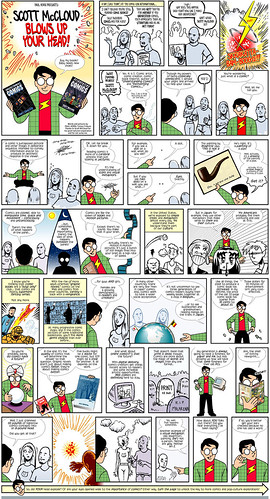
Scott McCloud is a comic author and theorist, who has pushed the boundaries of comics (and all the visual arts in my opinion) to unimaginable dephts of understanding and innovation. I just recently came to know about his work and I regret so much not having familiarised myself with it before. Thanks go to my director at Red Star studio, Benjamin Smith, for the recommended reading... cheers Ben!!

From the vast amount of amazing facts and theories that Scott explains, I wanted to post here something that has bugged me for years, since childhood, and probably the main reason that things like animation and drawing, as we all understand it in a commercial sense, are mainly tagged as "something just for kids"....one of the many "million dollar" questions...


What is a cartoon?


Most people will relate cartoons either to animation or drawings, and will not take it seriously at all (most people that I've met in real life anyway) since its main element is most of the time "humour". But I always thought the definition of the word "cartoon" had much more depth than such a simplistic assumption, and finally, thanks to Scott, I can safely say that it definetely comprises a much richer meaning.

The word cartoon, as defined in wikipedia, has changed and evolved over time. But its main essence, and the reason why we instantly think "2d" when we talk about cartoons, is because it's nature is that of an icon...it "resembles" whatever the creator of the cartoon wants to represent, in whatever level of detail desired. Scott Mccloud states that "by stripping down an image to it's essential meaning, an artist can amplify that meaning in a way that realistic art can't". What does this mean? In my opinion cartoons can reach different depths in telling a story than realism can. Obviously the opposite could also be true (I'm not a liveaction film maker nor photographer so I don't understand the full capabilities of such mediums, and I don't mean to dismiss any of these by comparing them to cartoons), but many people like me, who love animation and cartoons, who create their own and who try to tell stories through such mediums, identify themselves with the cartoon not because of its simplicity and efficiency to reach an audience in emotional ways, but also because of its universality.

Scott McCloud simply states that when who the messenger is matters less, what the message is matters more. That's why cartoons are so simple, rounded, childlike, efficient and understandable. Cartoons deal more with inner realities than the physical appereance, and this is why we can bring inanimate objects to life, because we emphasize in the idea we want to represent, not the original thing we want to represent...we can idealise our own little world, create our own stories, and populate them with our own characters....we have the freedom to play like gods....yet we can risk to go way too abstract as to no one understanding us...and this is when the element of "cartoon" kicks in: by getting inspired from elements of our reality, borrowing their essence, their appealing features, and whatever we want, we enrich and humanise those phantasies far more than a photoreal representation. We enhance the emotional value, the appeal, the empathy, and the communication of our story.


This is what cartoon is, and further more, in my opinion. This is why I'm doing animation, drawing and whatever releases my creative juice, because I feel free creating my own visions. I don't necessarily feel that cartoons should be just about humour. Is a form, not a genre. Is an artistic medium to express, whether animated or still, the essence of it is always "drawing". Drawing is predominantly 2d. And since I love drawing, I love cartoons too!

That's all for now. As a conclusion, I'll recommend to those of you haven't heard of Scott MCcloud yet, to purchase his book "Understanding comics", and absorb all that knowledge he exposes there...is pure gold. And don't think just because it has the word "comics" in the tile it limits itself to that medium...we all know that comics are another artform and therefore share lots of conventions with any other art...including animation!!


And here's a video of him giving a speech at TED.com about the power of comics, and the bright future that awaits.


Adios

Monday, February 9, 2009

Contrast can make a BIG difference!!

Hi all,

I've recently watched the film "La vie en Rose" and I personally thought it was a magnificent piece of work. Direction is great, the story is engaging and the actors performed really well, specially Marion Cotillard, who I'd like to talk about in this post as her performance is in my opinion what makes the whole essence of the film.

I invite you all to watch the movie first, and then take a look at this scene (I apologise in advance if I'm breaking any copyright laws by posting this, and I state that the only purpose of this is purely didactic; I am not the person who uploaded this video):


Biggest element that sticks out to me in this whole scene: CONTRAST....something so important in EVERY FORM OF STORYTELLING & ART, including obviously animation and character performance.

I was just blown away by the acting as well as the direction in this scene. Is all one shot, and from the happiest woman ever to be in love, she instantly turns into the most deppressive, paranoic and devasted person you could ever imagine. It all sounds very typical and lacking of any new elements, but the way it was delivered was just simply amazing.

Performance wise, Cotillard has pulled it off really well. Edith Piaf (as portrayed in the film) was a very expressive human being, who grew up in slums and poor areas of France, and she was always surrounded by rudeness and carelessness, which has molded her character and has had a major impact on her personality. Intelectual barriers and formalities are not there to stop her, and as she grows up she can overcome them by being her own self. But this scene is very special because you see her being capable of being beautiful and elegant on her own way, and respectfull, and noble, and embracing the goodness of humanity in its pure form...everyone experiences the feeling of love at some point in their lives and Edith was experiencing it THIS very time. What nobody knows is that she is just seeing visions, is a complete farse. But she lives every second of it full of joy and happiness. She is in love. She is living a fantasy.

Then direction drives her progressive change and desperation taking place....big house, random people appearing and intruding on her little moment of joy with her lover, nobody doing anything to help her out finding that watch she soo wants to give to the guy....she still retains that rude, careless, expressive personality inherent in her, and it manifests as soon as things start to go wrong. This whole bit is probably (as I see it) an anticipation to what's coming next, loss of control. Also the fact that is all in one camera shot makes everything more intense.

Performance at its best, Edith Piaf is told about her lover having died from a plane crash...nothing, in a split of a second, makes sense anymore...Is like all of a sudden someone sucked the last drop of water that was left in a huge glass. Everything is just hollow. She doesn't like it one bit, she was enjoying that last drop and it was taken out so quickly. She doesn't have time to react, no matter what she'll do, that water drop has been taken already, but she still tries to rectify this by "trying to drink anything that still remains in the glass" (or literally just going to check that Marcell was actually there with her, in the bedroom). Nothing is there, the water has gone for real. She is alone, in a desert of misfortune and hopelessness. She has lost it, and doesn't have a clue as to what to do. Her loneliness takes form and haunts her as all the things of her past are coming back without Marcell being there to share it all with her.

I might have gone a bit too far with the metaphor, I guess I enjoyed it a lot because I tend to be a very sensitive person at times. I like emotions and deep reactions from people. I find them to be the main reasons to drive someones actions in certain ways (I believe Ed Hooks would agree with me on this haha). My whole point is that thanks to contrast this whole scene was soo exciting to watch. It was such a simple concept, and it could have just been shown with the last bit of her having heard the news of Marcell dying and desperately crying, but it wouldn't have had the same effect at all. Contrast is not only about "Fat and thin, big and small, heavy and light..." when it comes to animation. Is not just a "physicall" thing, in my opinion. And this has proved it to me really well. The contrast here was needed as well...because it was what hinted us to the schizophrenic evolution of Edith's character.

Hope this all makes sense and that people understand what is it I'm trying to say...have a good day!

Saturday, January 31, 2009

WallE - a goldmine

Hello readers!

WallE has become a big international hit, and behind the kind little robot's cuteness there is an incredible amount of high quality work worth looking into. The interviews and podcasts with Stanton, the talks from the story guys, the hype from animators who have worked on this film....everything is full of so many interesting facts. I've seen it thrice, one of them dubbed into spanish, and is one of the few movies where language did not matter at all, preserving the emotional play between characters consistently all the way through. As an animator, I have learned that consistency in animation is one of the big things to achieve in order to make something good: consistency with character, consistency with model, consistency with your fellow animators views, consistency with the direction and story, consistency with the voiceover...


But what about the stage above the performance? What about the way this performance has been directed and shown on screen? Although I do personally think that the essence of this film was the soul of WallE as a living and breathing entity (he is no different from a microwave literally speaking, since he just switches on/off like any robot, but he exceeds that limitation and conveys emotional value to each and every action....he is "animated" in the pure sense of the word), I do also think that such element of the film wouldn't have worked the same way if they didn't orchestrated the movie the way they did. And the amount of work in the direction is just minute and absolutely fascinating...

Storyboard artist Karen J Lloyd has dissected in her blog several shots of WallE...the posts are worth a read (http://karenjlloyd.com/blog/2008/11/20/shot-tells-story-walle/). They're a bit old now I guess but I just came to find out!! From how to why, Karen has done a great overview and analysis on the directorial aspect of WallE. A great film with great animation...not just a film about animated characters.

And that's the dilemma: what's more important, story or character? Some prefer the former, others the latter. Whatever it is, I think if you excell in both you totally have the upper hand. Both have to work for the best out of a film, and Walle has achieved this balance greatly in my opinion.

Saturday, January 17, 2009

People training for dogs

Absolutely fascinating material...and so useful when comprehending animal psychology! Definetely useful for animation as well:


http://video.google.com/videoplay?docid=6361385827312960989

Observations on body language, attitude and power centers...Really cool and useful. Cesar Millán definetely has an eye for observation!

Sunday, December 7, 2008

Jason Ryan Webinar

I've just finished attending an Animation Mentor webinar with Jason Ryan, and I have to say it has been wonderful to see him animate live! Questions that were thrown around were also great, everything went pretty smooth and the two hours never felt long.


I managed to take some small notes....some of these emphasize on points that already most professional animators know...others where just tiny but revealing at the same time. I might be wrong in some of these though but this is overall what I got:

- generally character designs and inspiration sketches are made "before" the story reels...which is why a lot of times directors/storyboarders can get to draw key poses in their boards that fit with the character.

- 3d Layouts are mainly used for staging, composition and camera work, whereas 2d Storyboards/Animatics deal mainly with direction and also aid to decide on acting choices and help animators to nail the golden poses if drawn exactly the way wanted by the director.

- Jason Ryan's workflow, which involves a 2d pass in Flipbook prior to working in 3d, helps to coordinate and deal with both posing and timing "interactively", meaning that Xsheets are not really trusted...there has been a discussion among animators nowadays to whereas we are becoming lazy to just keep playblasting stuff til "it looks right" instead of knowing what we are doing beforehand...I got the impression Jason just easily sorts this problem by coming with ideas constantly via quick yet powerfull drawings, and still manages to have room for "interactive" repositioning and redrawing of poses.

- The more time you spend on your golden poses (keys+breakdowns), the less you will spend on the inbetweens.

- Jason prefers to create overlaps within the poses of the character, rather than offsetting things. Reason for this is that is much easier to reposition and tweak elements as a whole, rather than individual parts with their own different range of keyframes. Keying all the body controls of the character is what mainly helps to develop a workflow closer to the "2d" approach.

- Naturalistic animation is like caricature...is not really a full "cartoony" style...examples of this are the Incredibles humanoid characters, or the humans from the upcoming "Monsters vs Aliens", in which Jason is currently working.

- Cartoon and Naturalistic animations are generally snappier and faster than real life motion. That's why Jason said that we should be carefull not to rely 100% on any reference footage we might take for the purpose of helping us in doing our animation. Obviously if things are photoreal, more attention to reference from live action is required.

- Jason mentioned that 1 feet of animation is 16 frames, and there is a general requirement of creating 5 feet a week per animator (80 frames), although sometimes this can go up to 10 feet.

- Stereoscopic 3d makes approach to animation slightly different in certain aspects. There are times when shots need to be framed differently, because what we see is felt like a window to another world, with its own depth, instead of a flat monitor.
Eyelines in Stereoscopic 3d need to be spot on, otherwise they'll look wrong if slightly off. Also poses cannot break the frame...sometimes you're required to scale things (not literal scale but positioning with depth towards camera) intentionally in order to give certain effects, but you have to bear in mind they don't go out of the frame ever so slightly.


These notes were quite helpful. His animation session live was also great to watch. He also does the same in his tutorials, which you can purchase at www.jasonryananimation.com . Also you can purchase his Boris rig (I already have and is quite fun to animate with!!). Really great stuff, very inspiring!!

Thursday, August 21, 2008

Surpassing the uncanny valley phenomenon...

This video of the CG model "Emily" has been circulating around the net for quite some time now. It caught my attention how accurate and perfect does she look like.

This just looks perfectly real to me...I don´t even have to bother with the whole idea of her being CG or not, she is just being herself....as part of the realm of "our" reality, the "human" reality...outstanding achievement I think. If this footage was cutting to another person, on a set, sitting and talking, as part of the continuity with Emily's dialogue...I'm sure it would perfectly and seamlessly fit together.


If we start to dig into the moral usage, the implications and the purpose of such creation, there would be plenty of things to spot from both the good and bad sides. Like...why would anyone want to do this instead of simply shooting footage with a camera, for eg.? But that's a whole new level of discussion I don't really want to get into. I'm just amazed at how accurate this is...a big step in the CG industry probably...or all just something gimmicky...either way, i felt it was worth putting it in this space.

Saturday, July 19, 2008

Do schools kill creativity? By Ken Robinson

TED.com is an awesome website...This talk I´ve linked in this post is one of the best talks I´ve ever listened to (and to be honest I´ve almost enjoyed every talk they´ve done!!)...full of funny stories, interesting facts, entertainment... and broad analysis towards the concept of creativity in general. Some really important points to take into account... (thanks to my brother Jay for the link....gracias hermanitoooooo!!)

Sunday, July 6, 2008

From the eyes of a newbie...Martial Arts and Animation


Martial arts have always been one of my interests, not directly as a practice but as a big influence in the development of my tastes. With the advent of Kung Fu Panda, I've been intrigued by how the profound meaning and methodology of these arts could be related to animation somehow. And so I went on to join some classes for a start and, I’ve got to admit, it has played a major role in the way I perceive things.

Firstly I would like to give my insights in Kung Fu Panda. Such an inspirational masterpiece... A lot of things worked so well together and every frame of that film felt like a great painting/photograph you could easily have framed on your wall. From my experience, being a CG film, sometimes this is really hard to achieve. Lots of people I’ve talked to complain about how simple and straight forward the plot is....but that for me is the greatest element of it. Such a classical approach yet innovatively well put together, with really interesting personalities and rich environments. And the choreographies were spectacular, in terms of animation, direction and composition. I've also managed to purchase the "Art of" book and the amount of planning and conceptualisation is vast and rich. Every single element, from why some of the characters are dressed the way they are, to what kind of colours certain locations should convey in order to transmit specific moods and feelings for specific scenarios...everything is so well thought out. Some tend to justify by saying that obviously a lot of talented artists were involved, and that they can afford it with their ridiculous budgets. But even though if that was the case, I believe it's not easy at all have such coordination, vision, agreement, and energy to keep going till the end. If we start being picky we could mention things like how some of the characters remained very much kept in the background of the story and were not given more relevant challenges (i.e. the furious five), or how some gags were kind of predictable and perhaps a tiny little repetitive (i.e. Po’s colloquialisms), but these didn’t bother me at all and I think is a very good example of an analogy with the concept of a hero’s journey in “The Hero with a thousand faces” by Joseph Campbell. I really love this film. I love it.

Now to the martial arts stuff. I started on some classes of "Jeet Kune Do" (JKD) last week. JKD is a martial arts philosophy and discipline invented and introduced by Bruce Lee, so is quite a modern variation of Kung Fu which doesn't deal with any of the traditional routines. From the beginning of the lessons, I instantly felt so familiar with a lot of their principles. I'll mention some of these and I bet animators will be able to draw a lot of analogies that make perfect sense:

- JKD’s fundamental core is nothing but simplicity and effectivity. Quoting the master himself: "My movements are simple, direct and non-classical. The extraordinary part of it lies in its simplicity. Every movement in Jeet Kune-Do is being so of itself. There is nothing artificial about it. I always believe that the easy way is the right way. Jeet Kune-Do is simply the direct expression of one's feelings with the minimum of movements and energy."

- JKD’s training methodology evolves to suit ones needs. You start with what everyone knows by logic: punches and kicks, body mechanics. You pass on to usage of those in practicality (combat), and how the same mechanics can be used for different variations. Then you learn the flow, how some combinations could be entries and how others could be finishing moves; how ones are peaks and others are subtle moves. Finally, you interpret these yourself and you build your own way to get by.

- The essence of JKD relies in the way you develop it's elements further, so that your JKD skills will be enhanced and richer in depth. Such elements are mainly timing, distance and position (anything familiar here fellow animators?)

- Execution of most body mechanics starts from the hips. The bigger the recoil in the root, the bigger the anticipation of the upcoming move and the stronger such move will end up being. Also tension and rigidity must be avoided in order to let ourselves loose and avoid breaking of joints and articulations, and therefore having a smoother and more fluid motion. When executing moves, you should not do them one step after the other but rather let everything flow in an overlapping sequence to develop speed.

-Last but not least, if you listen to this interview there are some key points that Bruce Lee mentioned himself that you will find, although not really innovative, quite well put together and wisely spoken:


These are just a couple of observations I really wanted to share with everyone. I’m not an expert to evaluate these from every martial art’s perspective, hence I kept it to what I’m currently doing which is JKD. But I’m sure at least some of these are applicable on every art, being traditional or modern. Martial arts were created for combat but have evolved into other major forms as well, including dance, theatre, acrobatics and many other…and for me personally, has to do with how we canalise our inherent human aggressivity in a beautiful and healthy expression…an artistic expression, with no restraint in style. And at the same time, animation is not just about how we move things about to put them in motion, but rather how we express ourselves through such art…

Wow…A bit of a philosophical post….blame Dreamworks and the awesomeness of Kung Fu Panda!!